RBI Priority Sector Lending (PSL) 2025 Guide: New MSME Definition, Targets & Penalties
Everything that one needs need to know about Priority Sector Lending — explained in simple language with easy to understand flowcharts and structured tables
Effective: April 01, 2025
MSME Limits Revised 2.5x — w.e.f April 1, 2025
8 Priority Sectors Covered
What is Priority Sector Lending in 30 seconds?
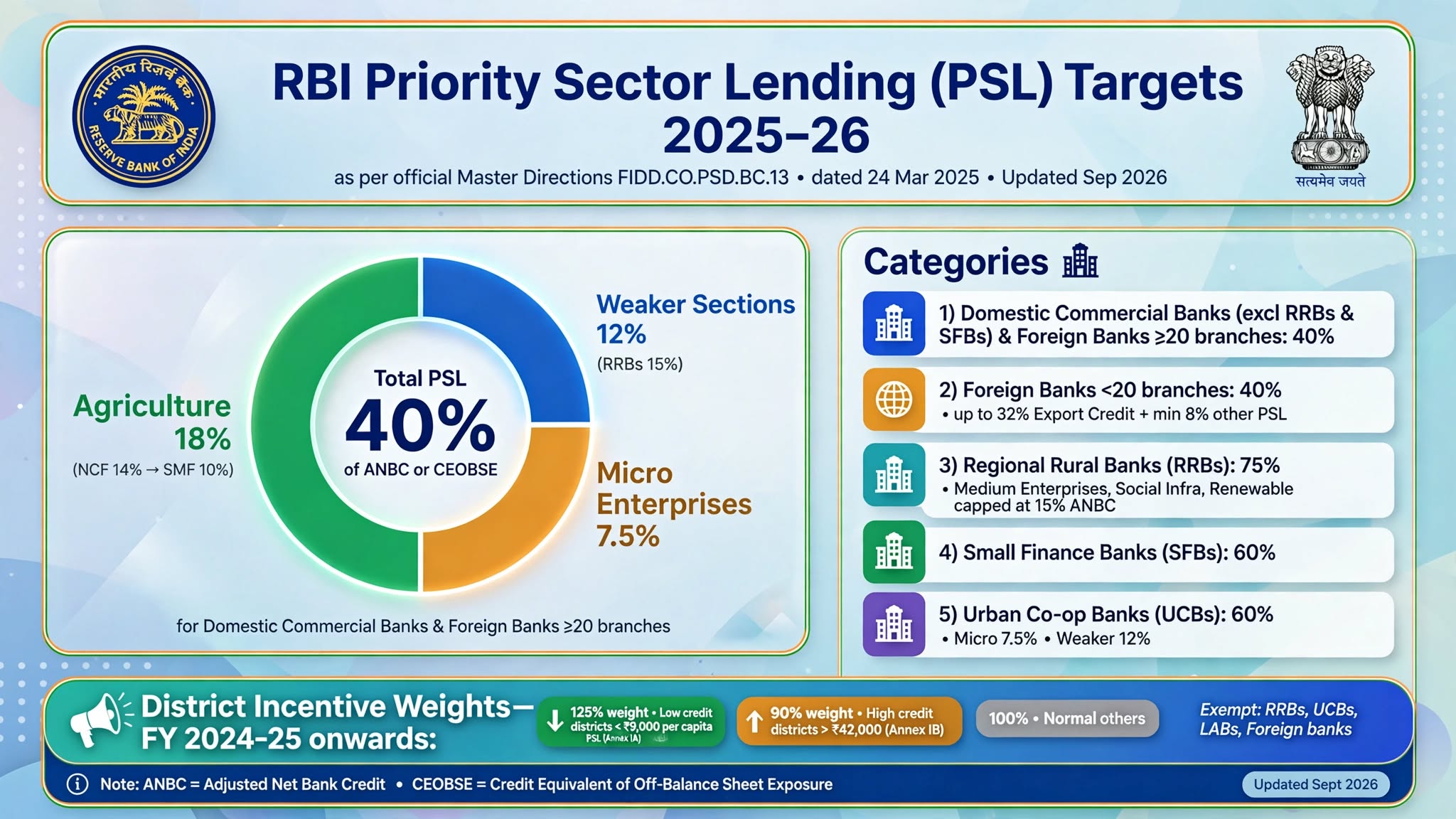
The Reserve Bank of India (RBI) mandates that Indian commercial banks deploy 40% of their total credit capacity (60% to 75% for Small Finance Banks, RRBs, and UCBs) to crucial sectors driving nationwide employment and grassroots economic development. Banks failing to hit these benchmarks must park shortfall amounts in low-yielding development funds like RIDF. This guide compiles the latest RBI Master Directions (consolidated through September 2026).
The Reserve Bank of India (RBI) mandates that Indian commercial banks deploy 40% of their total credit capacity (60% to 75% for Small Finance Banks, RRBs, and UCBs) to crucial sectors driving nationwide employment and grassroots economic development. Banks failing to hit these benchmarks must park shortfall amounts in low-yielding development funds like RIDF. This guide compiles the latest RBI Master Directions (consolidated through September 2026).
Why this guide is different: This visual manual breaks down the updated 2026 PSL Targets into process flowcharts and clear, structured tables suited for easier understanding.
🎯 1. Mandatory PSL Targets (% of ANBC / CEOBSE)
The RBI anchors compliance benchmarks against either Adjusted Net Bank Credit (ANBC) or the Credit Equivalent of Off-Balance Sheet Exposure (CEOBSE) as on the corresponding date of the preceding financial year, whichever figure is higher. As a result, banks work with a predictable, predetermined lending base throughout the year.
| Bank Classification | Total PSL | Agriculture | Micro | Weaker |
|---|---|---|---|---|
| Domestic SCBs & Foreign (≥20 branches) | 40% | 18% (10% SMF, 14% NCF) | 7.5% | 12% |
| Foreign Banks (<20 branches) | 40% (Max 32% Export) | — | — | — |
| RRBs | 75% | 18% | 7.5% | 15% |
| SFBs | 60% | 18% | 7.5% | 12% |
| UCBs | 60% | — | 7.5% | 12% |
🧮2. How ANBC is Calculated — Traditional Flow
Adjusted Net Bank Credit begins with total domestic bank credit minus rediscounted bills, adds back priority-eligible investments (such as RIDF deposits, PSLCs, and securitization notes), and excludes specific exemptions like long-term infrastructure bonds, recapitalization bonds, and designated foreign currency deposits.
Sequential Workflow: ANBC Calculation (RBI Para 6.1)
Step 1: NBC
Bank Credit – Rediscounted Bills
Step 2: Additions
RIDF + PSLCs + Securitisation + Non-SLR HTM Bonds
Step 3: Deductions
Infra Bonds + FCNR(B)/NRE + Recap Bonds
Step 4: Final ANBC
Determines PSL %
🏭3. ⚠ Latest MSME Definition — Effective April 1, 2025
Key Policy Update: Under the revised MSME classification framework effective from April 1, 2025, investment caps have been expanded 2.5-fold and annual turnover ceilings doubled compared to 2020 levels.
Prior to this revision, an enterprise investing ₹2 Crore in plant and equipment was excluded from the Micro category. Under the 2025 framework, it retains Micro status. This allows scaling enterprises to preserve access to concessional priority credit lines, priority factoring, and public procurement incentives without premature classification penalties. Note that both criteria (Investment and Turnover) must be satisfied simultaneously.
| MSME Category | Plant & Machinery / Equip. | Annual Net Turnover | Pre-2025 Limits |
|---|---|---|---|
| Micro Enterprise | ≤ ₹2.5 Crore | ≤ ₹10 Crore | ≤ ₹1 Cr / ≤ ₹5 Cr |
| Small Enterprise | ≤ ₹25 Crore | ≤ ₹100 Crore | ≤ ₹10 Cr / ≤ ₹50 Cr |
| Medium Enterprise | ≤ ₹125 Crore | ≤ ₹500 Crore | ≤ ₹50 Cr / ≤ ₹250 Cr |
Linear Tier Escalation: Updated MSME Limits
Micro (7.5% PSL Mandate)
Investment ≤ ₹2.5 Cr
Turnover ≤ ₹10 Cr
Turnover ≤ ₹10 Cr
Small Enterprises
Investment ≤ ₹25 Cr
Turnover ≤ ₹100 Cr
Turnover ≤ ₹100 Cr
Medium Enterprises
Investment ≤ ₹125 Cr
Turnover ≤ ₹500 Cr
Turnover ≤ ₹500 Cr
🌾4. Agriculture — 18% Target Architecture
Total lending to agriculture carries an overarching target of 18% of ANBC or CEOBSE. To ensure that institutional funding does not concentrate solely in corporate entities or capital-intensive infrastructure, the RBI strictly segments the 18% quota through mandatory sub-targets: at least 14% must go to Non-Corporate Farmers (NCFs), and within that, at least 10% must go to Small and Marginal Farmers (SMFs).
Three-Tier Agriculture Architecture (Chapter III, Para 9)
Tier 1: Farm Credit
Individual & Corporate farmers, allied units, SHGs/JLGs, and FPOs
Tier 2: Agri Infrastructure
Storage godowns, silos, cold chains, bio-gas plants (Up to ₹100 Cr)
Tier 3: Ancillary
Agro-processing (Up to ₹100 Cr), Agri-clinics, Custom hiring, PACS
Comprehensive Sub-Classifications of Agriculture
A. Farm Credit Sub-Divisions (Direct Cultivation & Allied)
• Crop & Term Loans: Short-term production finance (KCC loans), traditional/non-traditional plantation and horticulture credit, and purchase of tractors/farm machinery.
• Allied Activities: Dairy, fisheries, animal husbandry, poultry, bee-keeping, and sericulture are directly eligible as farm credit.
• Produce Pledge Loans: Loans up to ₹90 Lakh against Electronic Negotiable Warehouse Receipts (eNWRs) and up to ₹60 Lakh against other warehouse receipts for up to 12 months.
• Green Energy on Farms: Financing standalone solar agriculture pumps, solarizing grid-connected pumps, and solar power plants on fallow or stilted land owned by farmers.
• Distressed Farmers: Bank loans to distressed farmers indebted to non-institutional lenders (moneylenders) to prepay their debt.
• Allied Activities: Dairy, fisheries, animal husbandry, poultry, bee-keeping, and sericulture are directly eligible as farm credit.
• Produce Pledge Loans: Loans up to ₹90 Lakh against Electronic Negotiable Warehouse Receipts (eNWRs) and up to ₹60 Lakh against other warehouse receipts for up to 12 months.
• Green Energy on Farms: Financing standalone solar agriculture pumps, solarizing grid-connected pumps, and solar power plants on fallow or stilted land owned by farmers.
• Distressed Farmers: Bank loans to distressed farmers indebted to non-institutional lenders (moneylenders) to prepay their debt.
B. Agriculture Infrastructure (Cap: ₹100 Cr per borrower)
Loans for setting up essential agricultural infrastructure qualify under PSL up to ₹100 Crore per borrower:
• Storage Facilities: Warehouses, godowns, market yards, and modern silos.
• Cold Chain Infrastructure: Cold storage units, pack houses, and refrigerated distribution chains.
• Biotechnology & Soil Conservation: Soil conservation, watershed, tissue culture, seed production, bio-pesticides, vermi-composting.
• Bio-Energy: Oil extraction for bio-fuels and Compressed Bio Gas (CBG) plants.
• Storage Facilities: Warehouses, godowns, market yards, and modern silos.
• Cold Chain Infrastructure: Cold storage units, pack houses, and refrigerated distribution chains.
• Biotechnology & Soil Conservation: Soil conservation, watershed, tissue culture, seed production, bio-pesticides, vermi-composting.
• Bio-Energy: Oil extraction for bio-fuels and Compressed Bio Gas (CBG) plants.
C. Ancillary Activities
• Food & Agro-Processing: Up to ₹100 Crore per borrower (milling, preservation, milk processing).
• Agri-Startups: Up to ₹50 Crore for DPIIT-recognized startups in agriculture.
• Custom Service Units: Fleets of tractors, threshers, well-boring machines for contract farm work.
• Agri-Clinics & Agri-Business Centres (ACABC): Expert agronomy advisory centers.
• PACS / FSS / LAMPS: Loans to Primary Agricultural Credit Societies for on-lending.
• Agri-Startups: Up to ₹50 Crore for DPIIT-recognized startups in agriculture.
• Custom Service Units: Fleets of tractors, threshers, well-boring machines for contract farm work.
• Agri-Clinics & Agri-Business Centres (ACABC): Expert agronomy advisory centers.
• PACS / FSS / LAMPS: Loans to Primary Agricultural Credit Societies for on-lending.
Corporate vs Non-Corporate Farmers: Key Differences
The RBI enforces distinction between Non-Corporate Farmers (NCFs) and Corporate Farmers. This ensures institutional credit supports individual household cultivators rather than being consumed by corporate agribusinesses.
| Parameter | Non-Corporate Farmers (NCFs) | Corporate Farmers | FPOs |
|---|---|---|---|
| Legal Structure | Individual farmers, proprietorship, SHGs, JLGs. | Corporate farming companies, partnerships, cooperatives. | FPOs/FPCs of individual farmer members. |
| Sub-Target | Mandatory 14% of ANBC (includes 10% SMFs) | No separate sub-target. Counts toward 18% only. | Counts as SMF if ≥75% SMF members. |
| Loan Limit | No restrictive ceiling. Scale of finance based. | Capped at ₹4 Crore per entity | ₹10 Crore if assured marketing; ₹4 Cr otherwise |
| Produce Pledge | Up to ₹90 Lakh eNWRs; ₹60 Lakh others | Up to ₹4 Crore eNWRs; ₹2.5 Crore others | Up to ₹10 Crore for member produce |
| Landholding | Marginal ≤1 ha, Small 1–2 ha, landless qualifies for SMF 10% | Landholding irrelevant; credit cap applies | SMF if ≥75% land-holding share is SMF |
💼5. MSME — The 7.5% Micro Enterprise Priority
While all bank facilities extended to eligible MSMEs classify under PSL, the RBI enforces a dedicated 7.5% sub-target for Micro Enterprises. This ring-fences liquidity for small shops, artisan collectives, and cottage workshops.
MSME Priority Add-ons & Alternative Channels
• Khadi & Village Industries (KVI): All advances to KVI automatically count toward Micro Enterprise sub-target.
• MSME Startups: Operational credit up to ₹50 Crore qualifies for PSL.
• Factoring & Receivables: Factoring ‘with recourse’ and discounting through TReDS are eligible.
• On-Lending Support: Bank loans to NBFCs (other than MFIs) for on-lending to Micro and Small businesses eligible up to ₹20 Lakh per final borrower.
• MSME Startups: Operational credit up to ₹50 Crore qualifies for PSL.
• Factoring & Receivables: Factoring ‘with recourse’ and discounting through TReDS are eligible.
• On-Lending Support: Bank loans to NBFCs (other than MFIs) for on-lending to Micro and Small businesses eligible up to ₹20 Lakh per final borrower.
🏡6. Export, Education, Housing, Social Infra & Green Energy
Export finance covers pre-shipment raw materials and post-shipment invoice settlement. Education loans support studies up to ₹25 Lakh without restrictive collateral hurdles. Housing loans are bounded by population-linked dwelling costs to focus lending on affordable properties.
| Center Population Tier | Loan Limit | Max House Cost | Repair Limit |
|---|---|---|---|
| ≥ 50 Lakh (Metro) | ₹50 Lakh | ≤ ₹63 Lakh | ₹15 Lakh |
| 10 Lakh to 50 Lakh | ₹45 Lakh | ≤ ₹57 Lakh | ₹12 Lakh |
| < 10 Lakh (Rural / Towns) | ₹35 Lakh | ≤ ₹44 Lakh | ₹10 Lakh |
Social Infrastructure & Renewable Energy Ceilings
• Education: Up to ₹25 Lakh to individuals for higher or vocational studies in India or abroad.
• Social Infra: Up to ₹8 Crore for schools, drinking water, sanitation; up to ₹12 Crore for hospitals in Tier II-VI centres.
• Renewable Energy: Commercial generation (solar, wind, biomass) up to ₹35 Crore; individual rooftop solar up to ₹10 Lakh.
• Weaker Sections (12% Target): SMF, SC/ST, Women (up to ₹2 Lakh), PwD, Transgenders, PMJDY overdrafts.
• Social Infra: Up to ₹8 Crore for schools, drinking water, sanitation; up to ₹12 Crore for hospitals in Tier II-VI centres.
• Renewable Energy: Commercial generation (solar, wind, biomass) up to ₹35 Crore; individual rooftop solar up to ₹10 Lakh.
• Weaker Sections (12% Target): SMF, SC/ST, Women (up to ₹2 Lakh), PwD, Transgenders, PMJDY overdrafts.
🗺7. District Incentive Weights: Correcting Regional Credit Disparity
To stop banks from concentrating credit in a few areas, the RBI ranks districts by per-capita credit flow. Disbursing loans in credit-starved regions gets bonus weightage, while saturated regions face discounted weightage. Valid through FY 2026-27 (RRBs and UCBs exempt).
+125% Achievement Weight
Low PSL Credit Districts (Per capita < ₹9,000): For every ₹100 of incremental credit disbursed, RBI awards ₹125 in target achievement reporting.
90% Achievement Weight
High PSL Credit Districts (Per capita > ₹42,000): Every incremental ₹100 lent yields only ₹90 in regulatory PSL credit, discouraging over-concentration.
⚠8. Penalties for Target Shortfall: Mandatory RIDF Deposits
Banks cannot write off PSL shortfalls. Instead, deficient institutions must place matching funds into the Rural Infrastructure Development Fund (RIDF) and similar vehicles operated by NABARD, SIDBI, NHB, or MUDRA. Larger shortfalls result in steeper interest penalties.
| Overall PSL Target Shortfall | Interest Paid to Defaulting Bank |
|---|---|
| < 5 Percentage Points | Bank Rate – 2% |
| 5 to < 10 Percentage Points | Bank Rate – 3% |
| ≥ 10 Percentage Points | Bank Rate – 4% |
❓9. Frequently Asked Questions (FAQs)
🏭 MSME LimitsWhat is the updated MSME definition effective from April 1, 2025?
From April 1, 2025, an enterprise is classified as: Micro if Investment is ≤ ₹2.5 Crore and Turnover ≤ ₹10 Crore; Small if Investment ≤ ₹25 Crore and Turnover ≤ ₹100 Crore; Medium if Investment ≤ ₹125 Crore and Turnover ≤ ₹500 Crore. Both criteria must be satisfied simultaneously.
🎯 Lending TargetsWhat are the baseline PSL targets for Indian commercial banks?
Domestic scheduled commercial banks and foreign banks with 20+ branches must achieve overall PSL target of 40% of ANBC or CEOBSE, whichever higher. Sub-targets include 18% Agriculture (10% SMF, 14% NCF), 7.5% Micro Enterprises, and 12% Weaker Sections. RRBs must hit 75%, SFBs and UCBs 60%.
🌾 AgricultureWhat is the difference between Corporate and Non-Corporate Farmers in PSL?
Non-Corporate Farmers (NCFs) are individual farmers, partnerships, SHGs, JLGs. They benefit from protected 14% sub-target and no restrictive credit ceiling on direct production loans. Corporate Farmers have no dedicated sub-quota, and their PSL farm credit eligibility is strictly capped at ₹4 Crore per borrowing entity (₹10 Cr for FPOs with pre-agreed marketing).
🛡 Common GuidelinesAre banks allowed to levy processing charges on priority sector loans?
No. Under RBI Common Guidelines (Para 30), banks are strictly prohibited from charging any loan-related service fees, inspection charges, guarantee fees, or ad-hoc processing fees on priority sector loans up to ₹50,000. For SHG and JLG group lending, this exemption applies per individual member, not to collective group loan.
📜 PSLC TradingWhat are PSLCs and do they transfer credit risk?
PSLCs are tradable market instruments through RBI’s e-Kuber portal that allow banks with surplus PSL achievements to sell priority compliance credits to shortfall banks. There is zero transfer of credit risk or underlying loan assets. The buyer buys only the right to report compliance, while risks, interest, recovery remain on seller bank.
⚖ Penalties & RIDFWhat happens if a bank misses its PSL target?
Deficient banks are allocated mandatory contributions to RIDF and other development funds with NABARD, SIDBI, NHB, or MUDRA. Penal interest rates apply: Bank Rate minus 2% for shortfalls under 5%, minus 3% for 5-10%, minus 4% for ≥10%. Shortfalls also restrict approvals for new branch expansions.

Well made, very easy to understand 👍