Last updated: 24 September 2026
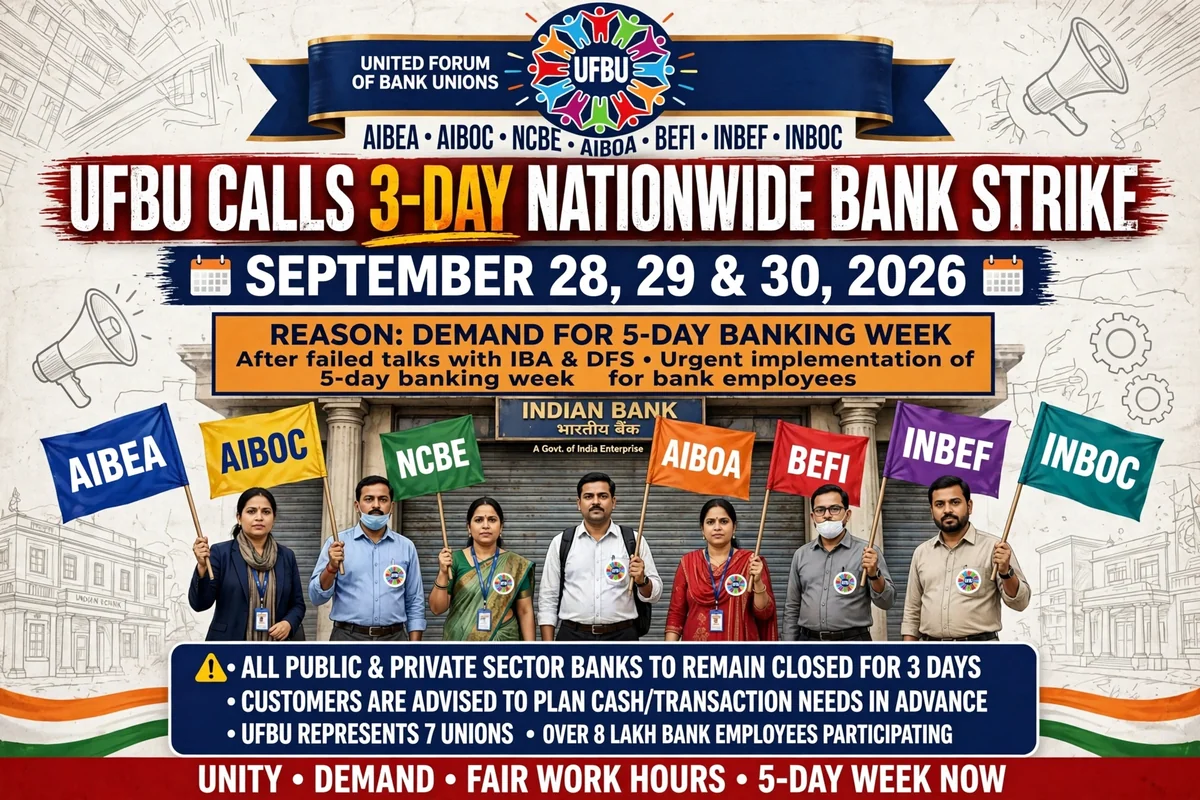
The United Forum of Bank Unions (UFBU) has confirmed a three-day nationwide bank strike on 28, 29 and 30 September 2026. In a last-minute countermove, the government has ordered public-sector banks open on Sunday 27 September instead — a move with its own legal and operational risks, covered below.
- Strike dates: Monday 28 – Wednesday 30 September 2026
- Called by: UFBU — 7 bank employee/officer unions
- Core demand: Five-day banking week (all Saturdays off)
- Countermove: PSU banks ordered open on Sunday 27 September
- Possible next step: Indefinite strike from 26 October 2026
- Branch impact: Shut on 4 of 5 days — 26, 28, 29 and 30 September
Why are bank unions striking?
UFBU has narrowed the dispute to one central grievance, plus two others it wants settled at the same time.
1. A five-day banking week
This was agreed in the wage settlement signed on 8 March 2024: all Saturdays would become holidays, in exchange for 40 extra minutes of work each weekday. Banks and the Indian Banks’ Association (IBA) signed on; the government never formally notified it. Over 18 months later, it’s still officially “under consideration.”
2. The Performance-Linked Incentive (PLI) scheme
A revised PLI scheme rolled out in November 2024 lets senior officers (Scale IV and above) earn incentives worth up to a year’s basic pay. Unions call it one-sided, since it excludes the broader clerical and officer cadre. The government has since kept it “in abeyance” — a partial concession that hasn’t ended the standoff.
3. A list of residual demands
Unresolved items from the March 2024 settlement include staff recruitment shortfalls, moving newer employees from NPS back to a pension-style scheme, pension updation for retirees, a uniform dearness allowance formula for pensioners, higher gratuity ceilings, and medical cover for retired staff.
The counter-move: banks ordered open on Sunday
On 23 September, the Finance Ministry announced that all Public Sector Banks and Regional Rural Banks — branches, offices, ATM-linked branches and currency chests — would be fully operational on Sunday 27 September, so that customers’ banking needs “are not adversely affected for an extended period.” Private banks like HDFC and ICICI aren’t covered — this is a directive to government-owned banks specifically. UFBU responded the same afternoon: employees would attend, given the RBI’s official approval, but the 28–30 September strike itself stays on.
Full UFBU strike timeline: 2015 to 2026
The five-day week promise is over a decade in the making. Here’s every step, from the first partial concession to the strike now days away.
The long build-up (2015–2024)
- May 2015First bipartite deal: the 2nd and 4th Saturdays of each month become bank holidays. A five-day week is floated as a future goal.
- November 2020Unions raise the demand again. IBA and bank managements promise to revisit it at the next wage revision.
- 8 March 2024The 12th Bipartite Settlement is signed: all remaining Saturdays to become holidays, in exchange for longer weekday hours. Sent to the Finance Ministry for approval — and never notified.
- November 2024The Department of Financial Services introduces the revised PLI scheme for senior officers, which unions immediately call discriminatory.
The 2026 escalation
- 6 AugustTwo smaller unions (NOBW, NOBO) exit the forum, leaving UFBU with its current seven constituents.
- 23 AugustUFBU serves formal notice of a three-phase strike: one day on 11 Sept, three days on 28–30 Sept, then indefinite from 26 Oct — unless the five-day week, PLI scheme and pension demands are resolved.
- 2–9 SeptemberSBI, Bank of Baroda, PNB, Union Bank and other PSU banks file stock-exchange disclosures warning customers of possible disruption.
- 4 SeptemberIBA asks UFBU to defer the 11 September strike for more talks. UFBU refuses the same day.
- 8–9 SeptemberFirst conciliation meeting between UFBU, IBA and the Department of Financial Services ends without a breakthrough.
- 11 SeptemberPhase 1 strike held. Turnout is heavy in several regions. The government responds by keeping the PLI scheme “in abeyance” — settling one of three demands, but not the core one.
- 16 SeptemberAIBEA circulars tell every state unit to treat the 28–30 September strike as top priority.
- 21 SeptemberThe Finance Ministry publicly urges staff to call off the strike, flags the clash with the 30 September half-year closing, and asks the Home Ministry to arrange state-level security.
- 22 SeptemberSecond conciliation meeting: IBA says the five-day week is “under government consideration” and asks for a deferral. UFBU says it will only stand down for concrete progress. UFBU issues Circular No. 2026/26 confirming the strike stands.
- 23 SeptemberFinance Ministry orders all PSU banks and RRBs to stay fully operational on Sunday 27 September, to soften the closure. UFBU says employees will attend, given the RBI’s approval — the strike itself is unaffected.
- 24 September No further movement reported. Both the Sunday opening and the three-day strike remain on track.
- 27 SeptemberBanks open on a Sunday for the first time in this dispute — a one-off, legally-contested measure to process transactions before the strike.
- 28–30 SeptemberPhase 2 strike. Three-day nationwide action; 30 September also happens to be banks’ half-yearly closing date.
- 26 October →Phase 3, if unresolved: an indefinite, continuous nationwide strike begins.
The three strike phases at a glance
| Phase | Dates | Type | Status |
|---|---|---|---|
| Phase 1 | 11 September 2026 | One-day strike | Held |
| Phase 2 | 28–30 September 2026 | Three-day strike | Confirmed, upcoming |
| Phase 3 | From 26 October 2026 | Indefinite strike | Threatened if unresolved |
The risks running underneath this
Legal risk, for management
The Sunday-opening order rests on contested legal ground (see above). If that “ultra vires” argument is ever tested and upheld, it’s branch and zonal management — the people who actually kept counters open — who answer for it, not the officials who drafted the press note.
Industrial-relations risk, for the government
Forcing staff to give up their one guaranteed rest day, two days before a strike about having too few rest days, hands the unions a ready-made grievance. It risks hardening turnout on the 28th rather than softening the strike’s impact.
Operational and vigilance risk, for branches
Cash and currency-chest insurance cover doesn’t lapse on a Sunday, but claims depend on normal procedure being followed. A skeleton crew running an unfamiliar roster, with thinner supervision, is exactly when cash-handling lapses or unauthorised overrides go unnoticed.
Economic risk, if the strike proceeds regardless
A three-day shutdown landing on the half-yearly closing date affects cheque clearance, treasury operations, salary credits and EMI processing at national scale — a cost one extra Sunday of opening barely offsets.
What can bank employees do about it?
Given that fact that RBI has permitted PSU Banks to open on a Sunday, employees and unions have a menu of responses to the Sunday order — with very different legal risk profiles.
Lower-risk: insist on the paperwork
Unions have precedent for this — in 2020 and again in 2025, officers’ associations formally demanded to see the specific Gazette notification authorising a holiday to be treated as a working day, rather than accepting a verbal or circular instruction. Asking for it in writing costs management nothing if the order is sound, and creates a paper trail if it isn’t.
Lower-risk: hold management to the compensatory terms
Bipartite settlements typically require a compensatory off day and/or extra pay for holiday duty. Collectively insisting on the full, correct entitlement — not more, not less — raises the administrative cost of the order without breaching any rule.
Lower-risk: interpret the order narrowly
The order covers “banking needs of the public” broadly. Employees can reasonably confine Sunday service to what’s actually urgent — cash and passbook transactions — rather than extending it to discretionary work like fresh loan processing.
Who is behind the strike?
UFBU is an umbrella of seven employee and officer associations, covering staff at public-sector, private, foreign, regional rural and cooperative banks: AIBEA, AIBOC, NCBE, AIBOA, BEFI, INBEF and INBOC. Two smaller bodies, AIBASM and BKSM, have separately called matching strike dates. On the other side sit the Indian Banks’ Association (IBA), the Department of Financial Services, and the Finance Ministry.
How will this affect bank customers?
- Public-sector bank branches are expected to be shut or short-staffed on 28, 29 and 30 September — and possibly 26–30 September in effect, given the weekend before it.
- ATMs, net banking, mobile apps and UPI are expected to keep working, though availability can vary by bank.
- Cheque clearing, cash counter work, KYC and loan paperwork are the services most likely to be delayed.
- Striking staff won’t be paid for strike days — “no work, no pay” applies once UFBU calls an industry-wide strike.
- Banks are advising customers to finish urgent branch work beforehand and use digital channels where possible.
- Sunday 27 September is now a genuine window for branch visits — PSU branches are ordered open specifically to absorb the demand that would otherwise hit the following week.
Frequently asked questions
What are the bank strike dates in September 2026?
UFBU’s three-day nationwide strike falls on Monday 28, Tuesday 29 and Wednesday 30 September 2026.
Why are bank unions striking in September 2026?
The main reason is the five-day banking week, which unions say was agreed in the March 2024 wage settlement but never formally notified by the government. A disputed incentive scheme for senior officers and several pension-related demands are also on the table.
Will banks be closed for 5 days in a row?
No longer fully — the government has ordered PSU banks open on Sunday 27 September specifically to prevent that. Branches are still expected to be shut on 26, 28, 29 and 30 September — 4 of the original 5 days.
Will banks be open on Sunday, 27 September 2026?
Yes. The Finance Ministry has directed all Public Sector Banks and Regional Rural Banks to stay fully operational that day. Private banks aren’t covered by this order.
Is it legal for the RBI to order banks open on a Sunday?
It’s contested. Bank unions argue the law that lets the government declare a bank holiday doesn’t also let it convert an existing holiday into a working day — an objection raised before but never tested in court. The counter-view is that opening branches doesn’t change a cheque’s legal holiday status, only whether the doors are open.
Will ATMs and online banking work during the strike?
These are expected to keep functioning, since the strike affects branch staff rather than digital infrastructure — though availability can vary by bank.
What happens if the dispute isn’t resolved by the strike dates?
UFBU has announced a third phase: an indefinite, continuous nationwide strike starting 26 October 2026.
What can bank employees do about the Sunday opening order?
Lower-risk options include demanding the formal notification in writing, insisting on the compensatory off or extra pay their settlement provides, and limiting Sunday service to genuinely urgent transactions. Go-slow tactics and coordinated mass leave carry real disciplinary exposure under Indian labour law and aren’t risk-free alternatives.
Sources: ETV Bharat, Business Today, PSU Connect, UNI Global Union, Business Standard, The Tribune, and bank stock-exchange filings, reporting up to 24 September 2026. Strike plans can change on short notice — confirm with your own bank before relying on any date here.