Effective Oct 15 2026 • UPI fees Applicable
UPI Is Getting Its First-Ever Fee: Here’s Everything You Actually Need to Know
For nine years “UPI is free” has been as close to a national fact as India has. That changes — partially — from October 15, 2026. Here’s what’s actually happening, in plain language, with numbers you can check for yourself.
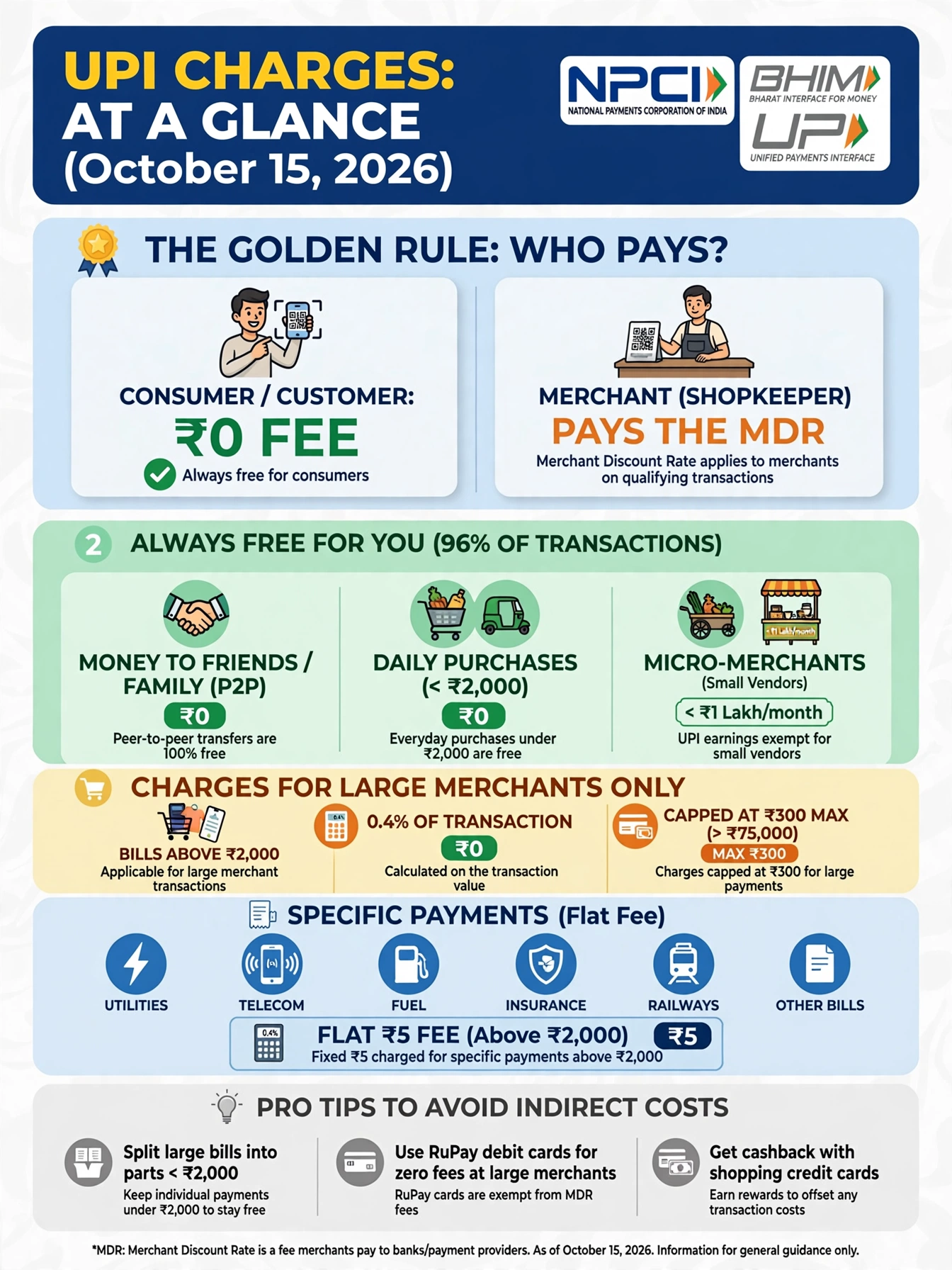
₹0 for you, alwaysConsumer/customer protected by law. You never pay MDR directly.
96% transactions freeP2P + all P2M below ₹2,000 + micro-merchants up to ₹1L/month = zero fee.
Only large merchants payAbove ₹2,000: 0.4% MDR, capped at ₹300. Utilities: flat ₹5 above ₹2k.
1. How We Got Here — Chronology
2016 — UPI launched by NPCI. Instant bank-to-bank.
Jan 2020 — Govt makes UPI zero-MDR by law to push adoption.
2020–2025 — Annual govt subsidy to compensate banks/NPCI.
June 2025 — Reports of MDR return. Finance Ministry denies as “baseless”.
Mar 2023 — PPI wallet interchange introduced, misreported as UPI fee.
10 Aug 2026 — Taxation Bill amends PSS Act Sec 10A — govt gets power to notify fees.
8 Aug 2026 — FinMin clarifies: P2P stays free, no blanket fee, threshold-based.
14 Sep 2026 — Notification: NPCI-headed steering committee can revise MDR.
15 Oct 2026 — New MDR framework comes into force.
2. The Charges — Clear Chart
| Transaction Type | Charge to Consumer | Charge to Merchant (MDR) | From |
|---|---|---|---|
| P2P — friends/family | ₹0 always free | — | — |
| P2M below ₹2,000 — chai, grocery, auto | ₹0 | ₹0 zero MDR | — |
| Micro-merchants up to ₹1L/month | ₹0 | ₹0 regardless of size | — |
| P2M above ₹2,000 (general) | ₹0 by law | 0.4% of value | 15 Oct 2026 |
| P2M above ₹75,000 | ₹0 | 0.4% capped at ₹300 | 15 Oct 2026 |
| Utilities (rail, telecom, insurance, fuel) above ₹2k | ₹0 | Flat ₹5 | 15 Oct 2026 |
3. What Will a Middle-Class Family Actually Pay?
Typical spend
₹50k/month household, ~60% via UPI = ₹30k
₹18–20k daily (<₹2k each) → ₹0
₹8–10k lumpy monthly >₹2k → MDR zone
₹1–2k yearly large one-offs → capped ₹300
₹50k/month household, ~60% via UPI = ₹30k
₹18–20k daily (<₹2k each) → ₹0
₹8–10k lumpy monthly >₹2k → MDR zone
₹1–2k yearly large one-offs → capped ₹300
Calculator: If merchant passes 0.4% onAmount subject to MDR: ₹8,000–10,000
MDR: 0.4%
Monthly indirect: ₹32–40
Annual indirect: ₹385–480
Legally: ₹0. Indirect only if merchant adds convenience fee. RBI discourages surcharging.
MDR: 0.4%
Monthly indirect: ₹32–40
Annual indirect: ₹385–480
Legally: ₹0. Indirect only if merchant adds convenience fee. RBI discourages surcharging.
4. Why Govt Says It’s Needed vs Why Critics Oppose
Govt view
- Running UPI costs ~₹20,000 cr/year
- Subsidy not sustainable, re-budgeted yearly
- Apps had zero revenue from UPI rails
- 96% txns untouched — narrow targeting
Critics view
- Merchants may prefer cash for high-ticket sales
- Future fee hikes via committee, not Parliament
- Trust deficit — called “baseless” in 2025, notified in 2026
- PhonePe 46% + Google Pay 33% benefit most
5. Can Govt Afford to Keep UPI Free?
| Item | Amount |
|---|---|
| Annual cost to run all UPI | ~₹20,000 cr/year |
| Bank loans written off (5 years) | ₹10.09 lakh cr (~₹2 lakh cr/year avg) |
| Recovery on written-off loans | 13–18% only |
Balanced take: Critics say ₹20k cr is 1% of annual write-offs — political will, not fiscal incapacity. Other side: write-off is accounting recognition of sunk cost, not fresh cash like subsidy; comparing is powerful but technically imprecise. Real issue is governance — future fee changes via notification reduce public scrutiny.
Pro Tips to Avoid Indirect Costs
✂️ Split large bills into parts <₹2,000Keep individual payments under ₹2k to stay free.
💳 Use RuPay debit cardsZero fees at large merchants — RuPay exempt from MDR.
🎁 Get cashback with credit cardsEarn rewards to offset any transaction costs.
FAQ — People Also Ask
Is UPI free for consumers after Oct 15 2026?
Yes. By law, the consumer pays ₹0 for all UPI — P2P and P2M. MDR is paid by the merchant to the bank/NPCI, not you. P2P is always free regardless of the amount.
Which UPI payments will have a fee?
Only merchant payments (P2M) above ₹2,000. Below ₹2,000 and micro-merchants up to ₹1 lakh/month remain zero MDR. Above ₹2,000: 0.4% MDR, capped at ₹300. Utilities above ₹2,000: flat ₹5.
Will I be charged extra at shops?
Legally no. But merchants may indirectly pass the 0.4% via higher prices. RBI discourages surcharging. Estimated indirect impact: ₹32–40/month if fully passed on.
Do small vendors and kirana stores pay?
No. Micro-merchants (P2PM) doing up to ₹1 lakh/month via UPI QR pay zero MDR regardless of size. Chai, grocery, and auto rides remain completely free.
What is MDR and who gets the money?
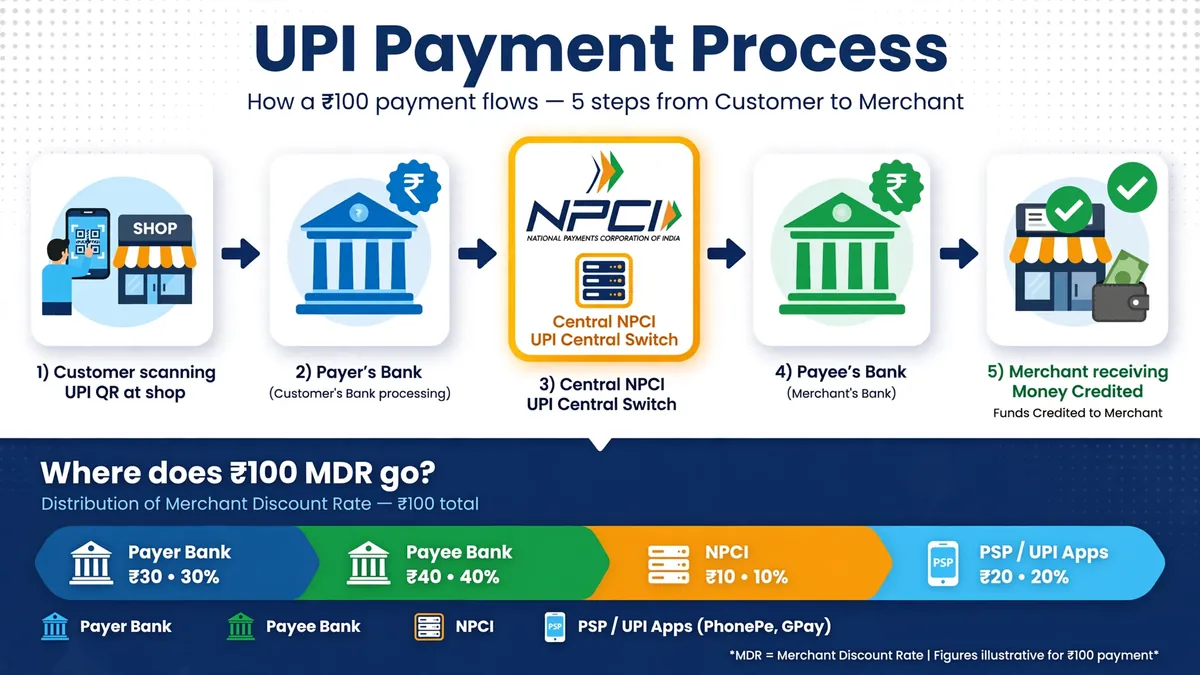
Merchant Discount Rate (MDR) is the fee a merchant pays for using UPI rails. It covers the ~₹20,000 cr/year cost to maintain the network. PhonePe (46%) and Google Pay (33%) handle ~80% of volume.
Can fees increase without Parliament?
Yes. After the Sep 14, 2026 notification, the UPI and Services Steering Committee headed by NPCI can revise the MDR via notification, without needing a fresh Act.