The Perquisites Tax Trap: Why It’s Draconian, Unfair, and Needs to Go
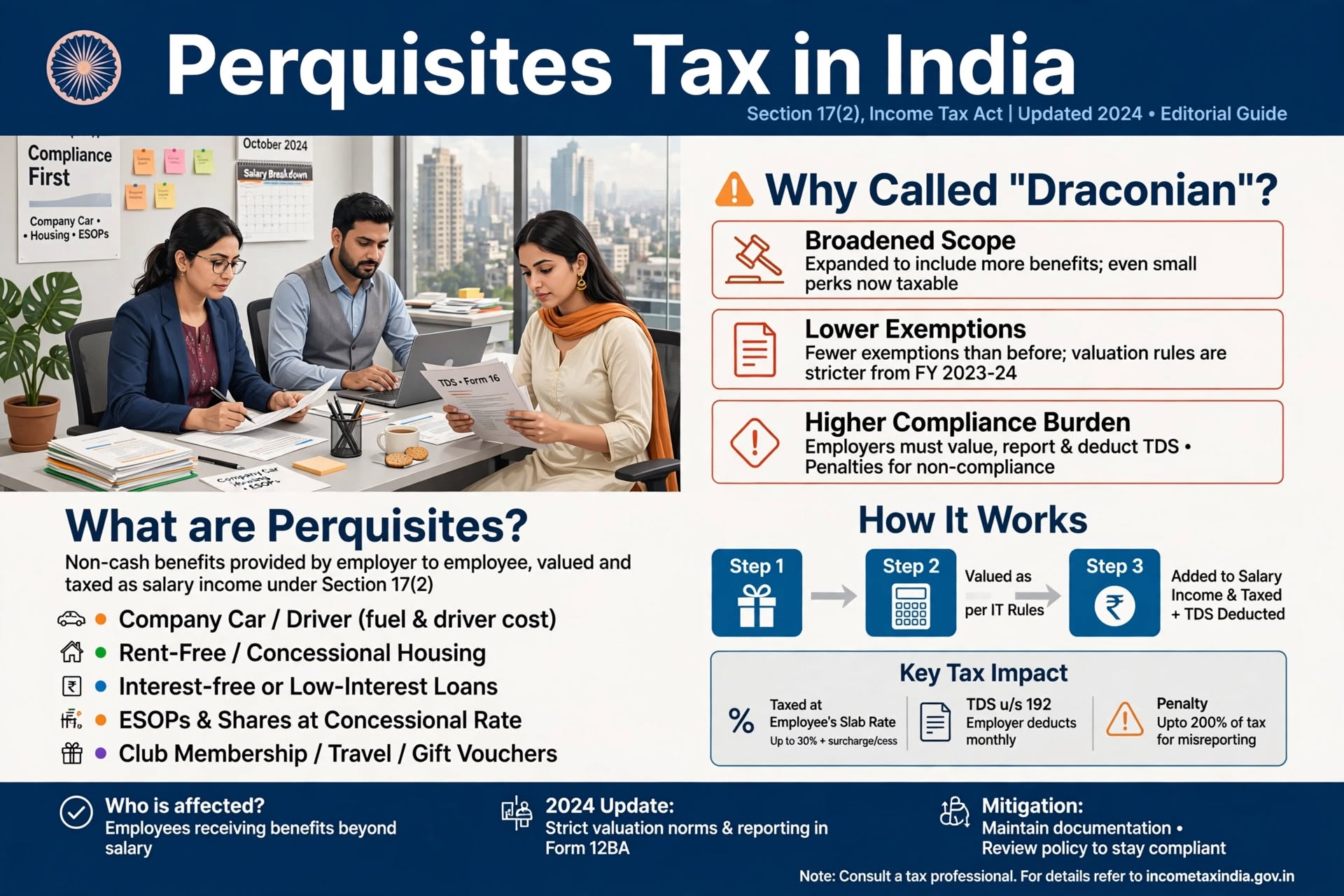
In the vast and complex landscape of Indian taxation, few things sting the salaried professional quite like the Perquisites Tax (Section 17(2) of the Income Tax Act). Designed ostensibly to tax “fringe benefits”, it has morphed into an aggressive tool that disproportionately burdens both private and public sector employees.
📋 The Exhaustive List: What the Taxman Considers a “Perk”
(Hover over or tap any item below to see how the government taxes it!)
⚠️ Why Perquisites Tax is a “Draconian” Law
To understand the frustration of the salaried class under the FY 26-27 tax structure, we must look at how this tax operates in reality. It doesn’t just tax actual cash income; it taxes notional value, phantom gains, and comparative benefits.
Taxing “Phantom” Money (ESOPs)
The most brutal example remains ESOPs. When a startup employee exercises stock options, they are forced to pay a massive perquisite tax on the “Fair Market Value” of the shares. The catch? The company is unlisted. The employee hasn’t made a single rupee in cash yet, but must pay taxes out-of-pocket on paper profits. If the startup later fails, the tax paid is never recovered.
The Loan Illusion
Imagine your employer (like a PSU Bank) gives you a concessional housing loan at 5% interest as an employee welfare benefit. The taxman steps in, compares this to the SBI rate of, say, 8.5%. That 3.5% difference on a ₹50 Lakh loan (₹1,75,000/year) is added to your income and taxed at your slab rate. You are penalized for securing a good internal deal!
The Corporate Squeeze
Business owners write off cars, travel, and meals as “business expenses” to legally reduce their tax liability. The salaried employee, however, is taxed heavily on the exact same things if provided by an employer (like standard vehicle perks or travel allowances). It aggressively assumes every employer benefit is an active cash equivalent.
⚖ The Great Divide: Who Really Pays Perquisite Tax?
To expose the sheer hypocrisy of the perquisite tax structure, let’s look at how the ruling class, administrative class, and quasi-government employees are taxed compared to a standard private-sector employee.
A Rent-Free House is provided to 5 different professionals. Each has a base salary of ₹30 Lakhs per annum. Let’s calculate the tax they pay just on this housing perk (assuming the 30% slab rate under the New Tax Regime).
| Profession Category | Perquisite Valuation Rule | Value Added to Income | Tax Paid on Perk |
|---|---|---|---|
| 🧑⚖️ The Judiciary (Supreme Court / High Court) |
Completely exempt. Under Section 23D of the SC Judges Act, rent-free residences and conveyances are entirely tax-free. | ₹0 | ₹0 |
| 🎙️ The Politician (MPs / MLAs / Ministers) |
Completely exempt. Perks (sprawling Lutyens bungalows, electricity, travel) are completely shielded under Section 10(17). | ₹0 | ₹0 |
| 🏛️ The Bureaucrat (IAS / IPS / Central Govt) |
Valued at the nominal “Government License Fee” (approx. ₹1k to ₹3k/month), totally ignoring the multi-crore market rent of their bungalows. | ₹24,000 (Avg ₹2k/month) |
₹7,200 |
| 🏦 The PSU Banker (SBI / Nationalized Banks) |
The Worst Hit: Despite being public sector, they fall under “Other Employees”. Their aging staff quarters are taxed at a brutal up to 10% of their salary. | ₹3,00,000 (10% of Salary) |
₹90,000 |
| 💼 The Private Sector (Corporate Employee) |
Taxed ruthlessly based on a flat statutory rate (up to 10% of salary) or actual lease rent, regardless of the employee’s choice. | ₹3,00,000 (10% of Salary) |
₹90,000 |
*Calculations are simplified for illustration purposes based on FY 26-27 (New Tax Regime) valuation rules for tier-1 cities (10% RFA limit applied at the 30% tax bracket).
🚀 Why It Must Be Scrapped Immediately
The perquisite tax does more harm than good to the economy. It disincentivizes corporate welfare and punishes standard employees. Here is why it must go:
- 1. Eradicates Glaring Hypocrisy A tax system must be fair. If the lawmakers, policy drafters, and judiciary are exempt from paying market-rate taxes on their sprawling bungalows and unlimited perks, it is a moral failure to squeeze the private sector middle class and PSU bankers for basic housing and transport.
- 2. Saves PSU Bankers from Unfair Penalties PSU bank officers are routinely transferred to expensive tier-1 cities and provided deteriorating bank quarters. Because they do not qualify for the “Central Government” license fee exemption, a massive chunk of their salary is taxed as a “perk” for a house they wouldn’t have rented on the open market.
- 3. Stops the Startup Brain Drain Because of the draconian tax on ESOP exercises, top tech talent is migrating to low-tax havens like Dubai and Singapore. Scrapping perquisite tax on unlisted shares until the employee actually sells them for cash would instantly supercharge the Indian startup ecosystem.
- 4. Promotes True Corporate Welfare If perquisite taxes are abolished, companies will be heavily incentivized to build housing townships, provide top-tier health facilities, and offer electric vehicles to their employees without indirectly shrinking the employee’s take-home pay.
📝 Frequently Asked Questions (FAQs)
What is perquisite tax in India?
Perquisite tax is a tax levied on the fringe benefits or non-cash perks provided by an employer to an employee. These include rent-free accommodation, company cars, ESOPs, and concessional loans. The government assigns a “notional value” to these perks and adds it to the employee’s taxable income under Section 17(2) of the Income Tax Act.
How is a concessional housing or vehicle loan taxed?
If your employer provides a loan at an interest rate lower than the prevailing State Bank of India (SBI) lending rate, the difference in the interest amount is considered a taxable perquisite. For example, if SBI charges 8.5% for a home loan and your employer charges 5%, the 3.5% difference is calculated on the outstanding loan balance and added to your taxable salary.
Why do PSU Bankers pay higher perquisite tax than Bureaucrats?
Central Government employees (like IAS/IPS officers) are taxed based on a heavily subsidized, nominal “Government License Fee” for their accommodation (often just ₹1,000-₹3,000/month). However, PSU Bankers (like SBI officers) are classified as non-government employees. Their housing perk is calculated as a flat percentage of their salary (up to 10%), resulting in a tax burden that is often 10x to 15x higher than a bureaucrat living in a much better property.
Are politicians and judges exempt from perquisite tax?
Yes. Due to specific legal exemptions—such as Section 10(17) of the Income Tax Act for MPs/MLAs and Section 23D of the Supreme Court Judges Act for the judiciary—these classes of officials do not pay perquisite taxes on their rent-free sprawling residences, vehicle allowances, or utility perks.
Will the New Tax Regime (FY 26-27) abolish perquisite tax?
As of the FY 2026-27 budget structure, the perquisite tax rules remain actively in place. While standard deduction and slab rates have been tweaked under the New Tax Regime to offer relief to the salaried class, the draconian calculation of perquisites like RFA (Rent-Free Accommodation), ESOPs, and Loans still adds massive notional income to an employee’s tax burden.
The Bottom Line
The perquisites tax is a relic of an era where the government sought to extract every possible penny from a highly restricted, narrow tax base. Today, it acts as a penalty on employee welfare, a wealth-destroyer for startup employees, and a nightmare for PSU workers. It is time for India to adopt a fairer system—one where tax is paid on real cash realized, and where the rules apply equally across the board.